






Success in the modern academic landscape is rarely the result of brute force. It is the result of strategy. For undergraduate students aiming for elite master’s programs or competitive internships, the challenge is not just completing assignments; it is managing the intellectual load while maintaining a trajectory toward long-term professional goals. The most successful students today treat their education like a high-stakes professional project—prioritizing, outsourcing where necessary, and optimizing their time for the tasks that yield the highest return on their future.
In an era where the requirements for top-tier university admissions and high academic standing are steeper than ever, students are increasingly looking for ways to streamline their workflow. Many find that relying on do my assignment services allows them to maintain a high GPA without sacrificing the time needed for networking, internships, or personal growth. By offloading time-consuming, repetitive tasks, students can focus their finite energy on mastering core concepts and building a competitive profile for their next professional step. It is about working smarter, not just harder.
The Economics of Academic Time Management
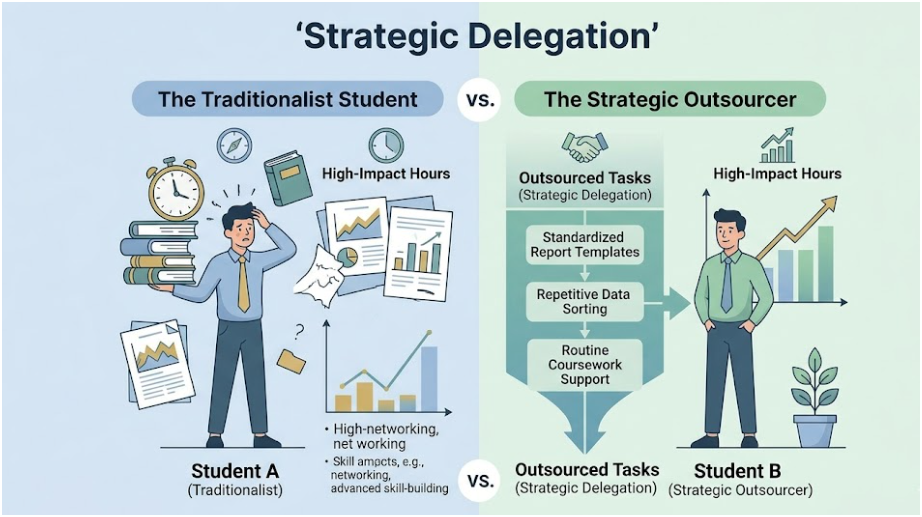
Time is the most valuable asset any undergraduate possesses. A student’s week is a finite container; every hour spent struggling with a foundational report that doesn’t advance their specific career path is an hour lost on independent research, side projects, or career preparation. High-achieving students recognize the principle of comparative advantage—if they can delegate a repetitive project to a specialist, they free up mental bandwidth for higher-value activities.
This isn’t about cutting corners; it is about resource allocation. In the professional world, delegating is a hallmark of leadership and operational efficiency. In the academic world, it is a hallmark of a student who understands that their time has a cost. Students who balance their responsibilities effectively often utilize professional assistance for their regular coursework. This ensures that their grades remain consistent while they dedicate their prime cognitive hours to complex problem-solving or skill-building that will actually matter in their future careers. When you stop viewing every assignment as a massive hurdle and start seeing them as tasks to be managed, you reduce the stress that leads to burnout.
Strategic Planning: Beyond the GPA
The transition from undergraduate studies to graduate school or high-end professional roles is governed by specific documentation. A high GPA is the baseline, but the differentiator is often the candidate’s narrative—how they articulate their path, their motivations, and their vision. This is where the Statement of Purpose (SOP) becomes the most critical document in a student’s portfolio.
Writing an SOP is an exercise in deep introspection, but it is also a rigorous technical writing challenge. It requires a level of polish that few undergraduates have mastered under pressure. Because an SOP is the primary filter for competitive admissions committees, many ambitious students turn to a professional sop writing service to ensure their vision is communicated with the clarity, tone, and professional standard expected by top-tier institutions. Myassignmenthelp is a resource often utilized by students who understand that their application needs to meet global standards of excellence, ensuring that their personal story aligns perfectly with the rigorous expectations of their target programs. This professional touch transforms a standard application into a compelling argument for why you belong in the program.
Comparison of Student Strategy Styles
| Strategy Type | Focus | Primary Goal | Result |
| Traditionalist | Doing everything alone | Hard work | High stress, burnout risk |
| Outsourcer | Strategic delegation | Efficiency | Consistent grades, free time |
| Hybrid Planner | Focused learning | Skill Mastery | Sustainable performance |
Why Elite Programs Look for More Than Grades
When admission officers review applications, they are looking for “information gain”—data points that reveal something unique about the applicant. An SOP that follows a cookie-cutter template often gets rejected because it fails to demonstrate depth. It needs to show that the student has not just passed their courses, but has actively thought about the real-world application of their knowledge.
To stand out, students must weave a narrative that ties their undergraduate research, their extracurriculars, and their future aspirations into a cohesive story. This is difficult to do when you are also stressed about meeting a deadline for a mid-term paper or a minor elective credit. By choosing to seek support for regular coursework, you buy yourself the silence and mental space needed to draft a truly compelling application. Your academics stay on track, and your application gains the necessary gravitas to compete on a global scale.
Building a Sustainable Academic Workflow
To sustain high performance, you need a workflow that accounts for the unexpected. Finance, law, and engineering programs are notorious for their intense, deadline-driven environments. Students who thrive in these environments are those who build “buffers” into their schedules to handle high-pressure weeks.
- Identify Bottlenecks: Which subjects take the longest but provide the least long-term value?
- Standardize Templates: Use consistent formatting for all reports to save time.
- Prioritize High-Impact Tasks: Reserve your best hours for projects that build your core expertise.
- Leverage External Resources: Don’t hesitate to use specialized support for time-heavy tasks that don’t contribute to your specific career path.
By treating your education as a roadmap for your future career, you stop seeing assignments as infinite burdens and start seeing them as obstacles to be cleared as efficiently as possible. This mental shift is the defining characteristic of the high achiever.
The Role of Networking and Career Prep
Beyond assignments and applications, the modern student must also be a networker. The days of graduating with a degree and walking into a job are largely gone. Today, you need to engage with industry leaders, participate in forums, and perhaps even understand the basics of trading or financial markets, depending on your field. This requires time—time that is often swallowed by the standard academic workload.
When you optimize your time, you aren’t just getting better grades; you are building a life that allows for professional development. Whether it’s attending a virtual seminar on market trends or working on a personal portfolio project, the time you save by being strategic is the time you invest in your actual future.
FAQ: Frequently Asked Questions
Q.1: Is it ethical to seek professional help for academic assignments?
A: Utilizing professional academic guidance is common for students who need assistance with complex concepts or time management. It is about using resources to ensure you grasp the material while meeting strict deadlines, allowing you to focus on your larger goals.
Q.2: How early should I start planning my graduate application?
Ans: Ideally, you should begin the strategy phase in your second or third year. This gives you time to build your resume and refine your narrative well before the actual application cycle begins.
Q.3: Does using external writing services help with admissions?
Ans: Yes, in the sense that professional guidance ensures your application is polished, grammatically flawless, and professionally structured, which is critical when competing against thousands of other qualified applicants.
Q.4: How do I balance internships and a full course load?
Ans: Prioritize ruthlessly. Understand that you cannot do everything at 100% capacity. Use external support for time-intensive coursework so you can dedicate your prime energy to your internship, where real-world networking happens.
Q.5: What is the most important element of an SOP?
Ans: The narrative arc. Admissions committees want to see a clear connection between your past academic experiences and your future professional aspirations. If you can explain why you are a fit, you are halfway there.